AI Talent Wars: Superintelligence for Sale, Apply Within
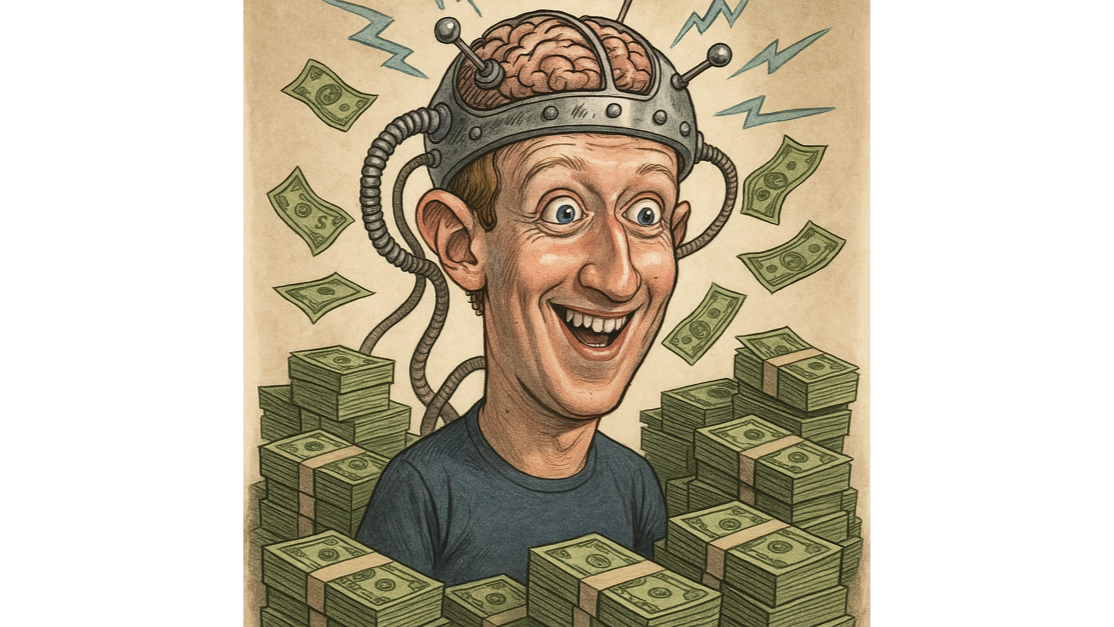
By now, Silicon Valley has seen its fair share of arms races. Chips. Cloud. Ride-sharing apps. But the current one? It isn’t about hardware or software. It’s about people. Specifically, the rare few who can bend the destiny of artificial intelligence, and, if Meta’s checkbook is to be believed, bend it for the tidy price of nine figures.
Welcome to the AI Talent Wars, the billion-dollar experiment where companies bid like auctioneers in a fever dream, and the winning strategy seems to be less “build great teams” and more “wave around more zeroes than your rivals.”
Meta’s Superintelligence Quest
At the center of this latest drama is Mark Zuckerberg, a man who has already rebranded an empire, purchased entire realities (hello, Oculus), and now apparently decided that what humanity really needs is the first artificial superintelligence smarter than all human intelligence combined.
The plan? Assemble a squad of AI Avengers by raiding competitors’ rosters. Forget the subtle art of cultivating a research culture or setting a coherent strategy, just poach the talent to do it. And poach Meta has. The headlines read like the credits of a blockbuster Marvel sequel, except the superpowers are linear algebra, reinforcement learning, and the ability to make ChatGPT blush.
Take Matt Deitke, a 24-year-old AI wunderkind whose career trajectory would make most Ph.D. candidates question their life choices. Initially offered $125 million, Deitke’s value doubled overnight when Mark Zuckerberg personally intervened, upgrading the offer to $250 million over four years. Forget a golden parachute, this was a golden rocket ship.
Next up: Ruoming Pang, a former Apple AI models lead. Meta reportedly lured him away with a package north of $200 million. In Cupertino, engineers polish iPhones. At Meta, apparently, they polish their bank accounts.
Then there’s Andrew Tulloch, co-founder of Thinking Machines Lab. Reports claimed he was offered as much as $1.5 billion over six years, a sum so absurd that Tulloch rejected it outright. Meta dismissed those reports as “inaccurate and ridiculous,” which in Silicon Valley usually means “we’d rather not talk about it.”
The Zurich pipeline also suffered. Lucas Beyer, Alexander Kolesnikov, and Xiaohua Zhai, researchers who had helped shape OpenAI’s European presence, were reportedly wooed with $100 million sign-on bonuses. Imagine explaining that to HR: “Yes, this is the budget line for snacks, this is the budget line for cloud credits, and this is the budget line for casually handing someone more than the GDP of Iceland.”
Meta’s coup didn’t stop there. Shengjia Zhao, co-creator of ChatGPT and GPT-4, defected from OpenAI to become Meta’s lead scientist for superintelligence. Meanwhile, Alexandr Wang, founder of Scale AI, traded the CEO chair for Meta’s Chief AI Officer title, sweetened by Meta’s purchase of a 49% stake in Scale worth $14.3 billion. It wasn’t just a job offer; it was a corporate merger disguised as onboarding paperwork.
From a satirical angle, the spectacle borders on parody. In a world where teachers are fighting for livable wages and nurses are striking for fair hours, a handful of AI researchers are commanding fortunes that would make an oil sheikh blush.
Picture the negotiation table:
Recruiter: “We’d like to offer you $125 million.”
Candidate: “Hmm, I was hoping for something life-changing.”
Zuckerberg, entering the room: “Make it $250 million and throw in unlimited Quest headsets.”
If this weren’t so real, it would be a Saturday Night Live skit.
If you’re feeling underpaid right now, don’t worry, you are.
The Price of Genius
What makes this spectacle both jaw-dropping and slightly comedic is the raw scale of the payouts. We’ve crossed from “competitive salaries” to “Mega Millions jackpot every Tuesday.”
Reid Hoffman, LinkedIn co-founder and Silicon Valley’s resident philosopher-capitalist, defended the madness. He called the bonuses “crazy,” yes, but also “economically rational.” If a single researcher holds the key to unlocking artificial general intelligence, then what’s a few hundred million between friends? But there’s a counterpoint, too, and it comes from inside Meta. Yann LeCun, Meta’s own Chief AI Scientist and a Turing Award winner, recently shrugged in an interview that he “doesn’t get paid that much.” Translation: he’s either a saint, a masochist, or someone who should hire a better agent.
The real irony here is that while Meta hemorrhages billions on salaries, the company seems to be forgetting a small detail: money doesn’t build culture, and money doesn’t lead teams. It can hire them, yes. It can dazzle them for a time. But great research requires more than quarterly bonuses; it requires trust, mission alignment, and leadership that inspires rather than just compensates.
The cracks are already visible. Several high-profile hires have reportedly left Meta after only a month, some even returning to OpenAI with their tails, or their stock options, between their legs. That should tell us something: nine figures can buy a contract, but not necessarily commitment.
Others have turned down Meta’s advances entirely. Despite offers rumored in the billion-dollar range, some researchers cited concerns over AI safety, ethical direction, or simply not wanting their life’s work to be branded with a corporate logo. Or, as one insider put it, “Mark Zuckerberg’s millions can’t buy loyalty.”
It’s a sentiment that should unsettle investors. For all the headlines about trillion-dollar valuations and “the first to build superintelligence wins,” the truth is painfully old-fashioned: you can’t bribe people into caring.
Meanwhile, inside Meta’s own walls, the veterans aren’t exactly thrilled. Longtime Fundamental AI Researchers (FAIR is Meta’s AI research lab), many of whom spent years defending Meta’s reputation as a hub of open-source AI are suddenly rubbing shoulders with newcomers pulling down $200 million packages. The mood, reportedly, is somewhere between resentment and mutiny.
Imagine being the engineer who built Meta’s AI infrastructure brick by brick, only to find yourself reporting to a 28-year-old billionaire brought in from outside. It’s less Avengers, more Succession.
Some whisper that this cultural clash is more dangerous than the talent war itself. Because building artificial superintelligence, if it’s even possible, will require not just brilliant minds but synchronized ones. And as any leader knows, teams that don’t trust each other rarely change the world.
What It Really Takes to Build Greatness
Here lies the core irony. For all the billions Meta is shelling out, there’s little evidence that compensation alone translates into the organizational alchemy needed for success. The tech industry is littered with expensive failures: lavish budgets, star-studded teams, and nothing to show but shareholder lawsuits.
Artificial superintelligence, if it ever comes, will be the product of leadership, vision, and collective purpose, not just a payroll ledger with extra commas. Great teams aren’t bought. They’re built.
For all the noise about billion-dollar salaries and “AI Avengers,” history offers a humbler truth: great teams are rarely forged in gilded conference rooms or bank vaults. They are built in the crucible of challenge, where shared purpose matters more than personal payout.
Consider NASA’s Apollo program. The moon landing in 1969 was not the result of nine-figure offers to rocket scientists, but of collective vision, tens of thousands of engineers, technicians, and astronauts united by a mission that transcended themselves. Many worked grueling hours, not for glory or money, but because they believed in pushing the boundaries of human possibility.
Or take the Manhattan Project, a team of the greatest scientific minds of the 20th century who, despite the moral complexity of their mission, demonstrated what relentless focus and coordination can achieve under pressure. These were individuals motivated by urgency, responsibility, and a belief (right or wrong) that their work would change the fate of nations.
Even in more recent memory, look at the early days of the internet. Small, underfunded groups of researchers at DARPA, Stanford, and CERN weren’t chasing nine-figure stock grants. They were chasing a connection, literally. Out of those scrappy beginnings came protocols, standards, and infrastructure that underpin the global economy today.
The common thread? Purpose. The belief that the work matters. The sense that the effort is bigger than the individual.
Great leaders understand this. They cultivate not just talent, but trust. They create conditions where people feel ownership of the mission, where failure is a stepping stone rather than a career-ending event, and where resilience grows from the shared conviction that the destination is worth the struggle.
If Meta, or any company racing toward artificial superintelligence, wants to achieve more than headlines and inflated payrolls, it must embrace this truth. Money attracts, but mission sustains. Paychecks hire, but purpose inspires. And it is only inspired teams that endure long enough to achieve greatness.
#ArtificialIntelligence #Superintelligence #GenerativeAI #MachineLearning #DeepLearning #AIResearch #AITalentWars #FutureOfWork #TalentAcquisition #TechCareers #Leadership #TeamBuilding
TAG Infosphere David Hechler Michael McKenna Stephanie Amoroso Edward Amoroso Lester Goodman John Rasmussen Joanna McDaniel Burkey